Optimization at scale & speed traditional solvers cannot reach
Chora - Tramm’s GPU-powered optimization engine - solves complex transportation planning and vehicle routing problems in seconds.
Why Chora
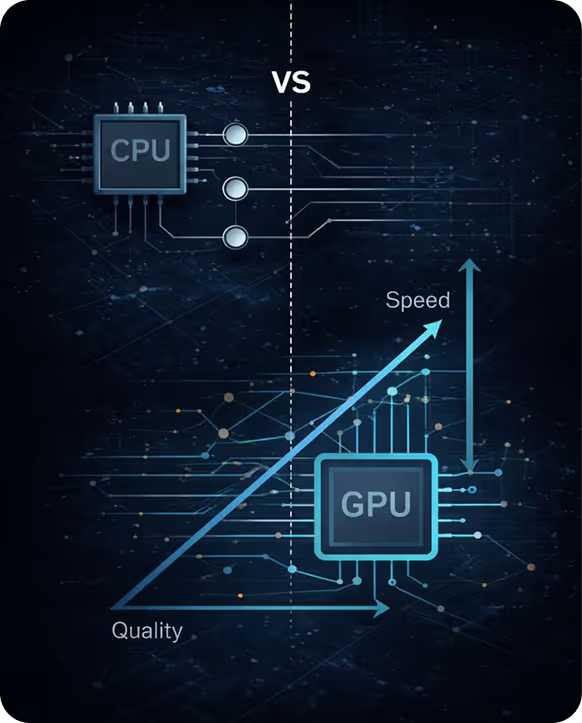
Most transportation optimization engines were designed for batch planning on CPU-based architectures. As transport networks grow in size and volatility, this forces a compromise between speed, solution quality, and responsiveness.
Chora removes that compromise.
Built on GPU architecture, Chora parallelizes optimization at a scale traditional solvers cannot, delivering faster, higher-quality results under real-world constraints.

What makes Chora different
• GPU-powered by design – built for massive parallel optimization, not sequential processing
• Seconds, not hours – supports frequent re-planning as conditions change
• Enterprise scale – handles large problem sizes without simplifying constraints
• Designed for execution – optimization that works within real operational time frames
What Chora Delivers
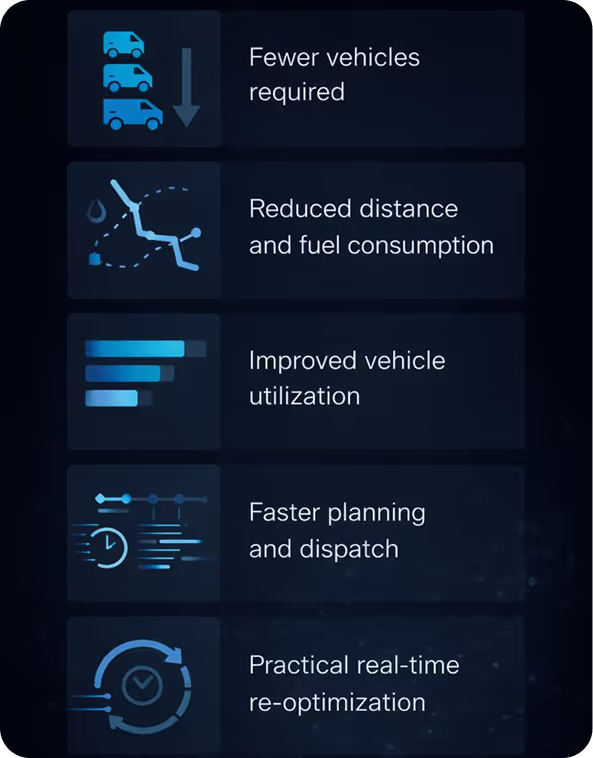
• Fewer vehicles required
• Reduced distance and fuel consumption
• Improved vehicle utilization
• Faster planning and dispatch cycles
• Practical real-time re-optimization
Proven in Production
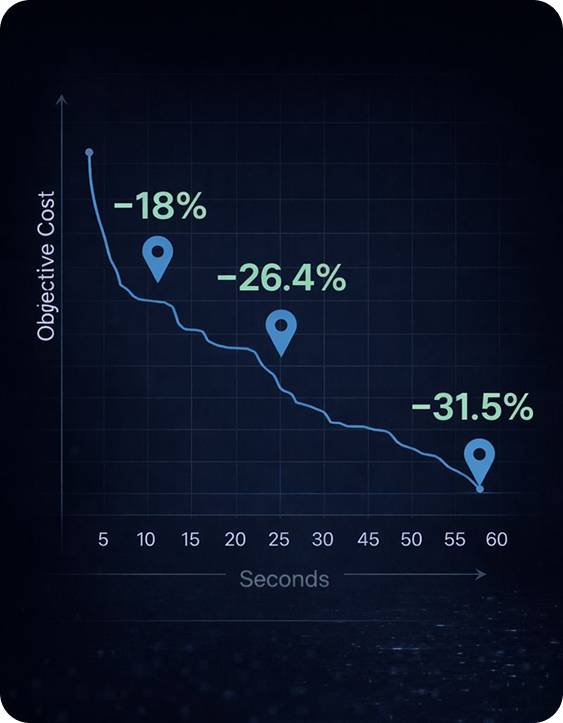
Chora is deployed in live customer environments and bench-marked against leading commercial solvers, demonstrating significantly faster solve times and higher-quality solutions under real-world conditions.
Full bench-marking details are available in the Chora White Paper.

Built for Complex Transport Networks
Chora is designed for organizations where planning speed, scale, and solution quality directly impact service levels and cost — including large shippers, retailers, and logistics service providers managing complex or mixed-fleet operations.
Full benchmarking details are available in the Chora White Paper
Automate your orders according to custom configurations and give your customers their own portal to manage orders.

Visualize and plan optimized routes for transportation in different environments–multi-modal, cross-docks, primary and secondary distribution–while easily making real-time adjustments in a dynamic environment.

Manage the entire trip lifecycle, including internal and external transporters, tendering, tariffs, rates, documentation, and invoicing.

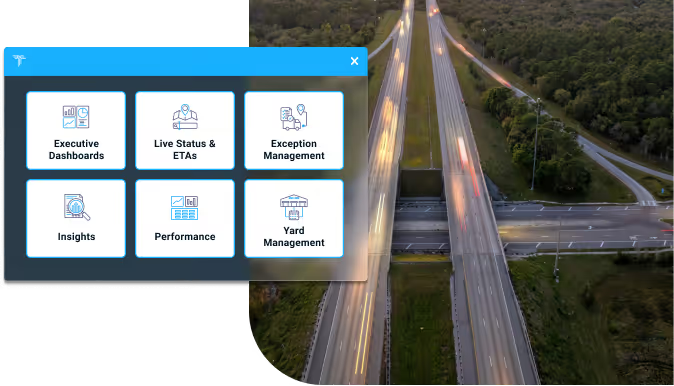
Stay in control with planned versus actual execution management, real-time ETAs and tracking, communication, customizable alerts, and performance analytics.
Give drivers on-the-go capabilities, from communication and ePOD submission to creating and performing custom workflows.

Get at-a-glance insights with comprehensive, customisable dashboards, reports, and performance analytics backed by real-time data.

Frequently Asked Questions
What is Chora?
Chora is Tramm's GPU-powered optimisation engine, built to solve complex transport-planning problems in seconds rather than hours. It is the solver behind Tramm's route optimisation — the 'Powered by Chora' brain that turns a pile of unplanned orders into the most efficient set of trips. By parallelising optimisation at scale, it delivers higher-quality solutions without compromising speed or operational responsiveness.
How does Chora relate to Tramm?
Tramm is the unified Transport Management System; Chora is the optimisation engine embedded inside it. When you select unplanned orders in Tramm's Planning module and hit Plan, Chora is what assembles the optimal trips. You never leave Tramm to use it — Chora works on the same live entity model as the rest of the platform, so its results flow straight into planning, dispatch and execution.
Who builds Chora?
Chora is developed by Opsi Systems, the team behind Tramm. It reflects decades of operations-research and optimisation expertise applied to real-world transport problems. That means the solver is purpose-built for logistics constraints, not a generic add-on bolted onto the platform.
What makes Chora different from a standard route planner?
Most route planners run on CPU-based solvers that grind through large problems in minutes or hours, which makes re-planning during the day impractical. Chora parallelises the optimisation across a GPU, so it explores far more of the solution space in a fraction of the time. The result is both faster answers and better answers — higher-quality routes that still respect every operational constraint.
Why does running Chora on a GPU matter?
Route optimisation is a massively parallel problem — there are enormous numbers of possible trip combinations to evaluate. A GPU can evaluate many of those possibilities at once, where a traditional CPU solver works through them far more sequentially. That parallelism is what lets Chora produce optimised routes in seconds instead of the minutes or hours typical of CPU-based solvers.
How fast is Chora in practice?
Chora is designed to return optimised plans in seconds, even on highly constrained problems spanning thousands of orders. This changes planning from an overnight or once-a-day batch job into something you can run interactively. Planners get answers while they are still looking at the screen, not after a coffee break.
Can Chora re-optimise during the day as things change?
Yes. Because solves complete in seconds, planners can re-optimise dynamically as conditions change — new orders arrive, a vehicle goes down, a time window shifts. This real-time re-optimisation is only practical because of the speed; a solver that takes hours cannot keep up with a live operation. Chora lets the plan stay optimal as the day unfolds rather than drifting out of date the moment it is generated.
With Chora, does faster optimisation mean lower quality?
No — speed and quality are not a trade-off with Chora. By parallelising optimisation at scale, it explores more of the solution space and produces higher-quality routes without sacrificing responsiveness. You get better plans and faster plans at the same time, rather than choosing one or the other.
What exactly does Chora optimise?
Chora assembles the most efficient set of trips from your unplanned orders — minimising distance, time and cost while respecting every operational constraint. It handles vehicle assignment, stop sequencing and routing across thousands of orders in a single solve. The goal is the lowest-cost plan that is still fully executable.
Which constraints does Chora respect?
Chora is a constraint-aware solver: capacity, time windows, product compatibility, vehicle class capability and restrictions, and operator-hour regulations are all honoured on every solve, from the first iteration. It is built to handle highly constrained transport-planning problems, not just simple point-to-point routing. Constraints are satisfied as part of the optimisation, so the plan it produces is one you can actually run.
Does Chora handle more than simple route planning?
Yes. Within Tramm's Planning module, Chora-powered optimisation covers multi-modal orchestration, cross-docks, and primary and secondary distribution. It also supports full-load scenarios where the aim is to maximise weight and volume fill per vehicle. One engine spans the different planning environments rather than needing a separate tool for each.
Does Chora show me why it made its choices?
Tramm presents every optimised plan on a live map alongside utilisation, distance and cost statistics in a single view, and surfaces any constraint breaches before dispatch through violation detection. So you see not just the routes but the metrics behind them, and any issues are flagged before the truck rolls rather than after. That transparency lets planners trust — and when needed, override — what the solver produces.
How does Chora fit with automated decision-making in Tramm?
Chora is the optimisation side of Tramm's decision-making, working alongside the LEE rules engine that automates operational decisions across the platform. LEE's 17 executers drive repeatable logic — for example, Order-to-Job and Job-to-Trip steps are already automated along the planning pipeline. Together, the optimisation engine and the rules engine form the decision brain that turns raw orders into executable, optimised plans.
What is Tramm's LEE rules engine?
LEE is Tramm's rules engine, comprising 17 executers that run the platform's operational logic and keep state consistent as work moves through the system. Every planning action propagates through LEE's state engine, so trips, jobs, movements, stops and orders stay in lockstep in real time. It is the mechanism that lets automated steps and optimisation results cascade cleanly through the whole operation.
How much of planning can Tramm automate end to end?
Significant stretches of the pipeline are already automated: Tramm can take unplanned orders, generate jobs and trips, and optimise routing with a single action. The design philosophy is automation with guardrails — the software can produce a recommendation or an optimised plan, and a planner stays in control of the final decision where it matters. This keeps speed and consistency high while keeping accountability clearly with a person for sensitive calls.
Can I still override or refine what Chora decides?
Absolutely. Chora produces the optimised plan, and Tramm's Manual Planner lets you refine it with drag-and-drop — re-sequence, reassign or split trips with a single gesture — while the LEE engine keeps state consistent behind the scenes. You can plan in the automated Planner, refine by hand, and reuse Master Routes, all on the same live data. Automation accelerates the work; it never locks you out of it.
How does Chora's output reach the rest of my operation?
Because Tramm runs on a single live entity model with real-time state cascades, an optimised plan from Chora immediately updates every connected trip, job, movement and stop. There is no export-and-reimport step between optimising and executing. The plan you solve is the plan your operation runs, kept in sync as things change.
What business results can Chora-powered optimisation deliver?
Faster, higher-quality optimisation drives lower cost per kilometre, higher vehicle utilisation and dramatically shorter planning cycles — hours of work collapsed into minutes. Because Chora can re-optimise in real time, you also recover cost and service that a static daily plan would lose as the day changes. The net effect is more deliveries from the same fleet at a lower cost to serve.
Who benefits most from Chora?
Operations with large order volumes, tight constraints and changeable conditions see the biggest gains — exactly the problems where CPU-based solvers are too slow to keep up. If your planners are waiting on long optimisation runs or re-planning by hand when disruptions hit, Chora's speed changes how the day is run. It suits multi-modal, cross-dock and full-load operations alike.
How do I see Chora in action?
The best way is a live demo on your own data — 45 minutes, real orders, live optimisation — so you can see the routes and the numbers for yourself. To arrange one, contact the Tramm team at info@tramm.global. We will show how Chora and Tramm turn your unplanned orders into optimised, executable plans in seconds.